We Ran 32 AI Queries for a Tampa Business. It Was Cited Twice.
When someone asks ChatGPT or Perplexity for a recommendation in your industry, what comes back?
Not your website. Not your Google reviews. Not the reputation you've spent years building. For most local businesses, the answer is: someone else.
I recently ran an AI citation gap analysis for a managed print services company in Tampa. I queried ChatGPT, Perplexity, Gemini, and Google's AI Overviews with the exact phrases a potential customer would use: "managed print services Tampa," "copier leasing Tampa," "best printer repair Tampa," and five more variations.
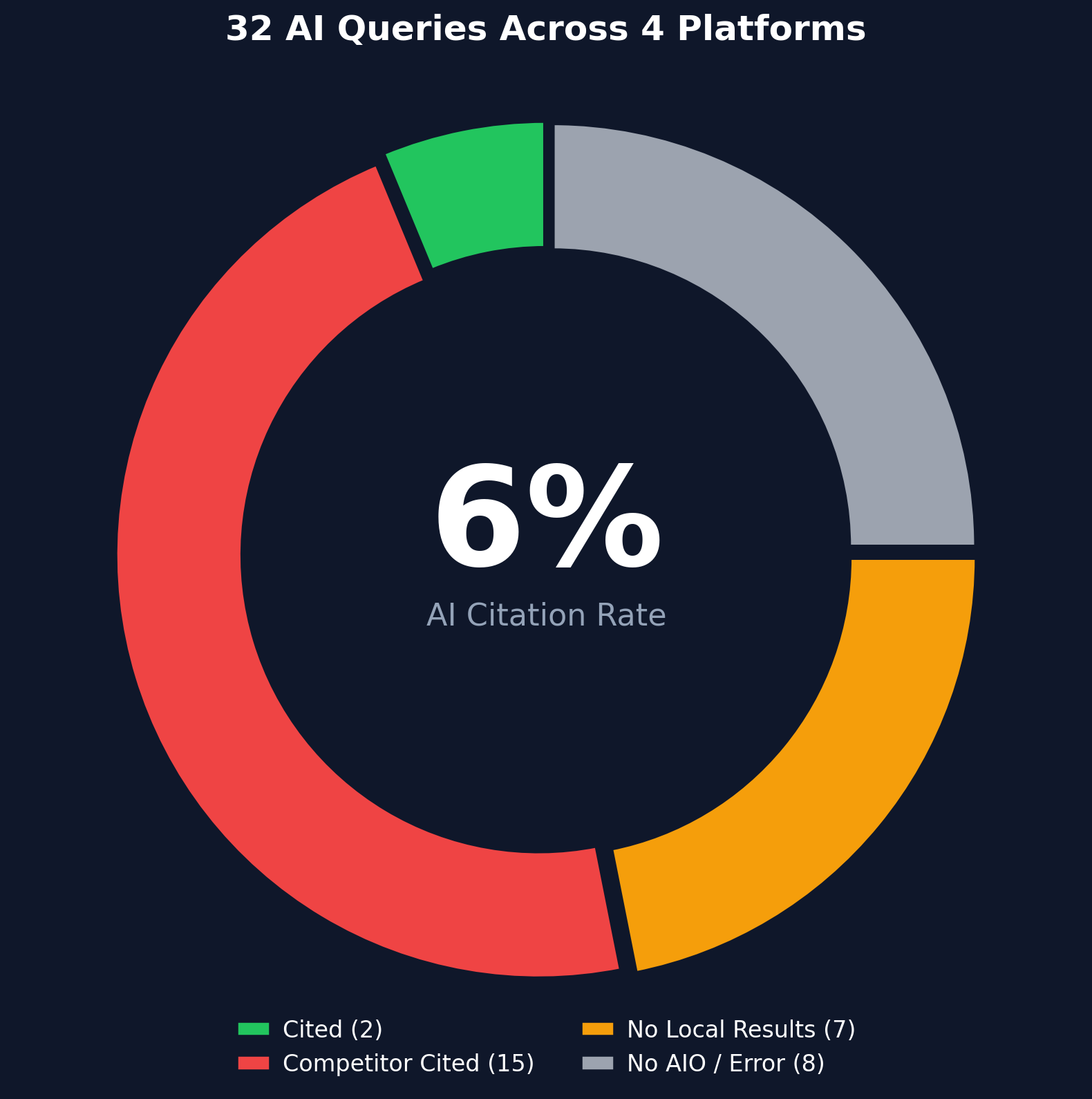
The results: 32 query-and-platform combinations. The business showed up in two of them. On 15 of those 32, a competitor was named instead.
What AI search actually does
When someone types "best printer repair in Tampa" into ChatGPT, the tool doesn't pull up a list of Google results. It reads web pages, reviews, and published content, then assembles a short answer naming the businesses it considers most relevant.
The key word is "considers." AI tools aren't random. They pull from specific web pages. If your business hasn't published content that answers the question being asked, you won't be in the answer. Your competitor who did publish that content will be.
This is different from Google search. With Google, you can rank on page two and still get some traffic. With AI search, you're either in the answer or you're not. There is no page two.
What I found
The most surprising finding: ChatGPT never mentioned the business by name. Not once, across all eight queries. It returned competitor results or generic national brands every time. Perplexity was the only platform that picked up the business at all, and only on two of eight queries. Gemini defaulted to national manufacturers. Google's AI Overviews didn't trigger for any of the queries.
Here's what made it worse. One competing domain showed up six times across all queries and platforms. It wasn't the biggest company in the market. It was the company with the most clearly written, specific content about managed print services in Tampa. Another competitor had a dedicated landing page for that exact phrase. A third had FAQ content written in a way AI tools could easily pull from.
The business I audited had strong reviews, a solid reputation, and real expertise. It just hadn't published the kind of content AI tools look for when building their answers.
The gap is the strategy
This is the insight most businesses miss. They publish blog posts and hope AI notices. What actually works is the reverse: find out what AI is already recommending for your target queries, then create content that fills the specific holes.
Most of the local SEO advice out there won't help you here. Optimizing your Google Business Profile, building backlinks, cleaning up your directory listings: none of that matters if AI tools can't find a single page on your site that answers the question being asked.
An AI citation gap analysis works like this: run your top service queries through every major AI platform (not just one, because each pulls from different sources), capture which websites and pages are being referenced, and map the gaps. Were you mentioned? Was a competitor mentioned? Was no local business mentioned at all? Each scenario tells you something different, and each one has a different fix.
If a competitor is getting recommended with weaker content than what you could produce, that's your highest-priority gap. If no local business is being mentioned at all, that's an open lane. The AI tool wants to recommend someone but can't find content worth pulling from. Be the first to fill it.
What earns a mention
AI tools don't just read your content. They read it looking for specific things: clear service descriptions tied to a named location, answers to common questions formatted so they're easy to extract, and pages that directly match how the question was asked.
Here's the difference in practice. The competitor getting cited had a page that opened with: "We provide managed print services to businesses across Tampa Bay. Here's what's included, what it costs, and how to know if it's right for your office." The audited business had a services page that said: "We offer a wide range of printing solutions to meet your needs." One answers the question. The other doesn't.
A page titled "Managed Print Services in Tampa Bay: What It Costs and How to Choose a Provider" will outperform a generic services page every time, because it matches the structure of the question a customer actually types.
Why this matters now
Six months ago, almost nobody was asking ChatGPT to find a local service provider. Now it's happening thousands of times a day, and that number is accelerating. In the Tampa managed print market, most providers haven't published any content written for AI visibility at all. The window is open. It won't stay that way.
If you want to see where your business stands, I built a free check that runs your business through the same AI platforms I used in this audit. Takes 30 seconds.
Find out what AI says about your business.
Run Your Free AI Visibility Check